Nieman Journalism Lab |
- OpenData Latinoamérica: Ampliando la demanda de datos y recolectando transparencia
- Would you click a “Respect” button more than a “Like” button? Experiments in tweaking news reader behavior for democracy
- Wednesday Q&A: Susan Glasser on heading to Politico, the state of foreign reporting, and balancing blogs and longform
| OpenData Latinoamérica: Ampliando la demanda de datos y recolectando transparencia Posted: 12 Jun 2013 12:15 PM PDT
Editor’s note: You may have seen our story yesterday on OpenData Latinoamérica, a new data-sharing platform launched recently by a group of Latin American journalists. So that it might be read more by journalists and others who might want to use the platform, here’s a translation of the article into Spanish. The translation is done by our dear friend and Nieman Fellow, the Chilean radio journalist Paula Molina. “Hay un dicho aquí que se relaciona con nuestro trabajo y que no implica que sea ilegal: es mejor pedir disculpas que pedir permiso“, dice Miguel Paz desde Chile. Paz es un veterano en el negocio de las noticias digitales. Y el dicho tiene que ver con su postura ante la búsqueda de datos públicos gubernamentales que podría tomar mucho tiempo obtener de otra forma. Paz también es becario de la Fundación Knight para el Periodismo, fundador de Hacks/Hackers Chile, y reciente ganador del Knight News Challenge. Hace pocos años fundó Poderopedia, una base de datos de políticos chilenos y sus conexiones a organizaciones políticas, gobierno y empresas. Pero liberar, organizar y publicar datos en Chile no es suficiente para Paz y por eso su próximo proyecto — en colaboración con Mariano Blejman de la red argentina Argentina’s Hacks/Hackers — está dirigido a liberar datos en toda América Latina a través del proyecto OpenData Latinoamérica. Paz y Blejman esperan armar una red centralizada donde almacenar y compartir los datos públicos de toda la región. La conexión a través de Hacks/Hackers es clave para el desarrollo de OpenData Latinoamérica. La red estará disponible para resolución de problemas y entrenamiento mientras el proyecto despega y hackers y medios aprenden tanto a subir datos como a usarlos. Otro socio clave para convertir OpenData Latinoamérica en una realidad es su conexión con el programa de Desarrollo Global del Banco Mundial World Bank Institute’s Global Media Development dirigido por Craig Hammer. Hammer cree que la era de los datos está revolucionando a los gobiernos, a las organizaciones no gubernamentales y los procesos de toma de decisiones. “La pregunta para nosotros es ¿Qué vamos a hacer con los datos? ¿Datos para qué? Construir un puente entre los datos disponibles y su traducción en mejoras para la calidad de la vida de las personas es un proceso que necesita tiempo y dedicación. En eso se focaliza nuestro trabajo programático”, dice Hammer. Un modelo a través del AtlánticoBajo la dirección de Hammer, el Banco Mundial colaboró en la organización y financiamiento de Africa Open Data, un proyecto similar a OpenData Latinoamérica lanzado por otro becario de la fundación Knight, Justin Arenstein. “Las mismas políticas de acceso a la información del Banco Mundial permiten hacer públicos sus datos y en ese proceso, la institución provee un soporte para que los países de la región también publiquen sus datos” dice Hammer. Africa Open Data se encuentra todavía en etapa beta, pero está reuniendo información, hackers y periodistas en proyectos de entrenamiento que ya han generado cambios en el periodismo. En un posteo acerca de la importancia de equipar al público para navegar en una nueva era de acceso a los datos. Hammer cuenta la historia de Irene Choge, periodista de Kenia que asistió a una sesión de entrenamiento del Banco Mundial en conjunto con Africa Open Data.
Hammer describe Africa Open Data como una prueba de stress útil para OpenData Latinoamérica, pero Miguel Paz dice que la base de datos para la región fue también un paso natural frente a la serie de frustraciones que él y Blejman encontraron en su trabajo. “Usualmente, el problema es que todo marcha bien antes y durante la hackathon” dice Paz. “Pero luego, ¿quiénes van a trabajar en los proyectos? ¿cuál es el status del proyecto? ¿cómo podemos seguirlo? ¿cómo pueden incorporarse otras personas?” La solución terminó siendo Hackdash, una creación de Blejman, y que constituye una interface que ayuda a los hackers a mantenerse al tanto de las respuestas para esas preguntas y por lo tanto, a reforzar el legado de varios proyectos. Pensar en formas de organización y comunicación para los hackers a través de América Latina no es algo nuevo para Paz y Blejman. “En una hackathon nosotros hacíamos algo y otra persona, sin saber nada del proyecto, hacía otro aporte. Así que cuando vimos la plataforma de Open Data Africa pensamos que OpenData Latinoamérica era una gran idea”, dice. Blejman dice que los aportes del Banco Mundial han sido claves para la fundación de OpenData Latinoamérica, especialmente para la organización de los “training bootcamps”. Hammer dice que él ve al Banco en el rol de construir un puente entre los hackers y los medios. “Más que una plataforma”, dice Miguel Paz, “es una institución que por sí misma ayuda a conectar fuentes de información gubernamentales y ayuda en la transformación de esos datos en conocimiento y conocimiento dirigido a la acción”. Dar a las personas las herramientas para comprender el poder de los datos es un principio importante de la filosofía de datos abiertos de Hammer, quien cree que la alfabetización en el manejo de datos es el próximo paso en el escenario creado por las grandes cantidades de datos públicos (Big Data). Hammer considera que este proceso de alfabetización es más inmediatamente importante para sectores específicos y estratégicos como el periodismo, los medios, los hackers cívicos y la sociedad civil”. Uno de los objetivos de Hammer es conseguir que instituciones como los periódicos, en vez de confiar en intereses individuales, adopten la importancia de comprender el manejo de datos. "No me refiero a que todo el planeta aprenda a visualizar datos", afirma, “lo que digo es que debería ser posible que estas habilidades las adquiriera cualquier persona interesada en ellas. Si pensamos en el acceso y manejo de datos públicos como el elemento democratizador real — como democratización sustantiva de la información — entonces los datos tienen que ser digeribles, accesibles y consumibles por cualquiera que quiera acceder a ellos”. Aumentar el interés del público por acceder a mayor cantidad de datos es lo que Hammer describe como estimular la demanda de datos. Para Hammer, es magnífico que los gobiernos estén dispuestos a transparentar los datos públicos, pero para que esos datos sean útiles, las personas tienen que comprender y utilizar el poder de los datos. “Lo que es interesante en OpenData Latinoamérica es que es una iniciativa que afecta el lado de la demanda, donde el público está liberando datos, recolectándolos, limpiándolos. OpenData no opera sólo en la esfera gubernamental. Es algo que también pueden hacer otras entidades que operan en el ámbito de lo público”. Como un ejemplo, en Argentina, donde el gobierno llegó tarde a la lógica de los datos abiertos, Blejman dice que vio cómo se desarrollaba una poderosa demanda por información pública entre los hackers y periodistas que lo rodeaban. “Cuando vieron lo que estaba pasando en otros países vecinos y las posibilidades que abría el acceso a los datos públicos, los argentinos pidieron lo mismo y el gobierno comenzó a entregar parte de sus datos”. “Tenemos que pensar en los datos abiertos como un servicio, porque no importan cuánto trabajen las ONG: las personas no se van a preocupar de los datos per se” dice Paz. “Las personas se preocupan de los datos porque afectan su vida, para bien o para mal”. Otra ventaja con la que contaron Blejman y Paz cuando decidieron inciar OpenData Latinoamérica fue la existencia de Junar, software chileno creado por Javier Pajaro, quien era un analista frustrado cuando decidió dedicarse a las plataformas de datos abiertos y ayudar a otros a hacer lo mismo. Según Blejman, mientras Africa Open Data optó por CKAN, el uso en OpenData Latinoamérica de una compañía local en español que ya era familiar para los integrantes de la red Hacks/Hackers ha fortalecido el proyecto, haciendo más fácil resolver los problemas cuando estos se presentan. También afirma que la habilidad de Junar para dar a las organizaciones involucradas mayor control sobre la plataforma se adapta muy bien con la visión de trabajo abierto y colaborativo que ellos visualizan para una futura operación diaria de la base de datos. Organizando esfuerzosPaz y Blejman tienen altas expectativas para el crecimiento de OpenData Latinoamérica y las historias que surgirán del proyecto. “Lo que esperamos es que la gente empiece a usar los datos, a entusiasmar a los periódicos para que se organicen en torno a los temas de datos y tener un puerto central a partir del cual puedan consumir los datos que deseen”, dice Blejman. Ambos esperan algún día reunir datos de cada país en Latinoamérica, pero reconocen que algunos serán más difíciles de alcanzar que otros. “En general, en los gobiernos federales es difícil estandarizar los datos. Así que en países como Argentina, que es un estado federado con distintas autoridades en distintos niveles, es más difícil estandarizar que en una república donde hay un estado”, dice Paz. “Sin embargo, en Chile, tenemos gran cantidad de datos, un gobierno abierto y transparencia, pero no tenemos gran periodismo de datos”. (Chile es una república.) En el futuro, también les gustaría ofrecer una manera segura de permitir que fuentes anónimas contribuyan con datos para el sitio. Paz dice que en su experiencia como editor, 20–25 por ciento de los golpes noticiosos provienen de fuentes anónimas. Pero a pesar de desarrollos como el reciente Strongbox de la revista The New Yorker’s, OpenData Latinoamérica todavía está trabajando en un método seguro que no requiera descargar Tor, y que sea más seguro que el email. Blejman agrega que, por ahora, tienen un control mínimo sobre la calidad y la precisión de la datos original con la que están trabajando: “En última instancia, no podemos controlar las fuentes originales, y estamos confiando en las organizaciones”. Pero sobre todas las cosas, lo que motiva a Paz es anticipar las historias que podrán contar. Paz planea usar documentos sobre compras públicas del Gobierno de Chile para construir una aplicación que permita a los ciudadanos hacer un seguimiento del gasto público, y de las compañías que beneficia. Otra historia en desarrollo ejemplifica en qué medida Paz tomó al pie de la letra los consejos de Craig Hammer en la construcción de una demanda de datos. En Chile, hay una significativa indignación estudiantil ante los crecientes costos de la educación y continuas protestas en favor de una educación gratuita. En respuesta, Paz decidió aprovechar esa energía y frustración en una #scrapaton que se realizará el 29 de junio en Santiago. Se focalizarán en conseguir datos de los dueños de las universidades, las compañías que tienen contratos con las universidades y los dueños de colegios privados y subsidiados. “Hay una broma que dice que si dejas a cinco gringos — y no digo gringo en una manera despectiva-, si dejas a cinco estadounidenses en una sala, probablemente van a inventar un cohete”, dice Paz. “Si dejas a cinco chilenos en una sala, lo más probable es que se peleen entre ellos. Así que no sólo estamos construyendo herramientas, también estamos construyendo formas de trabajar juntos y de mejorar la confianza entre las personas”. Blejman agrega que espera que la reciente publicación de una versión en español del Open Data Handbook (El manual de Open Data) facilitará aún más la colaboración entre los hackers Latinoamericanos. Con un proyecto de este tamaño y alcance, también hay un diseño ambicioso en torno a las métricas. Paz espera seguir cuántos proyectos se originan a partir de los datos de OpenData Latinoamérica. Craig Hammer quiere cuantificar el bien común que genera el acceso a los datos, un proyecto que ya está en camino a través de la Fundación World Wide Web (World Wide Web Foundation’s) en colaboración con Open Data for Development Camp. “Si existe un lazo evidente, reconocible entre los datos abiertos y un aumento en el bienestar común, entonces creo que podría existir un momento catalizador para el manejo de datos abiertos, que permitiría un reconocimiento más amplio de por qué es importante y por qué vale la pena invertir en ellos, y se podría generar un aumento explosivo en la difusión de la alfabetización en el manejo de datos”. Hammer quiere que la gente haga propios los datos y se dé cuenta de que pueden ayudar en la toma de decisiones en distintos niveles, incluso individual o familiar. Una vez que esas ventajas sean claras para la mayoría, la demanda aumentará y todo tipo de organizaciones se sentirá presionada a compartir su información”. “Hay una sensación visceral de que los datos son importantes y eso es bueno. Hay un reconocimiento de que abrir la información y hacer accesible los datos es un bien público en sí mismo. Pero eso no es todo, ¿no?”, dice Hammer: “eso no es el fin de un proceso, sino su inicio”. Foto de estudiantes marchando en la ciudad de Santiago entre gases lacrimógenos mientras la policía dispara cañones de agua, 8 de agosto, 2012. AP/Luis Hidalgo |
| Posted: 12 Jun 2013 10:09 AM PDT Talia Stroud of the University of Texas says she first became interested in how people choose their news sources in 2004. She was beginning to sense the rise of media polarization, so she started doing some research on why people seek out news from sources that are likely to confirm their own views — and what the implications are for American democracy. In 2011, Stroud published Niche News: The Politics of News Choice, which confirms the idea of “partisan selective exposure” and seeks to use this tendency toward self-selecting polarization to explain the interrelated workings of the media and the American political system. “The finding that makes me the most afraid,” says Stroud, “is the people who are most likely to polarize and look at like-minded media and exhibit some of these behaviors that I don’t think are pro-democratic are those who are most politically knowledgeable.” So what to do? One strategy, taken up by some journalists, is shaming: complaining loudly about how awful it is that conservatives only watch Fox News and read Drudge or that liberals only watch MSNBC and read Daily Kos. But while that may feel nice to the complainer, it doesn’t do much good to change behavior. Stroud wanted to try for something more actionable. The result is the Engaging News Project at UT, which received funding from The Democracy Fund, a project of the Omidyar Network via the New America Foundation, and which Stroud presented at the Personal Democracy Forum in New York last week. From the outset, Stroud resisted the temptation to come at the problem with a mind to create a newsroom revolution. Instead, she was looking for practical, easily implemented, small-scale solutions that local media partners could begin using and testing right away. “I wanted to develop something that would have two goals — one of which is a democratic goal and a second which is a business goal,” she said. “That’s quite doable in today’s media environment.” Stroud and her team started brainstorming tools that would not only encourage readers to engage in more diverse discourse online and expose themselves to new viewpoints, but which also had a chance of enhancing revenue for news outlets who already spend lots of time worrying about how to get more eyes on their pages for longer periods of time. “Before I started this project, I talked with a lot of people in a lot of newsrooms, from editors down to those who were like, ‘Hey, I’m a social media intern.’ There are some people who are only interested in the business angle, and there are some that are truly passionate about a democratic angle,” says Stroud. “I think the Engaging News Project is well positioned, because it can actually speak to both of those.” The team located four different features of online news sites that they wanted to experiment with — comments, polls, link framing, and buttons. The results of the comments experiment — which looks at the role journalists play in guiding conversation through questions and interaction — aren’t in yet, but the other three yielded provocative findings. A lot of news sites out there are using polls on their homepages to increase user engagement. Stroud asked whether there was a way to modify this trick to both make the polls both more informative to the reader and more interesting, so that they’d stay longer. Instead of asking questions about policy preferences — the results of which are likely unrepresentative of the broader public, anyway — she found readers learned more from being asked questions about existing poll data. In other words, asking “What percentage of the public approves of gay marriage, according to a recent Gallup poll?” generated more learning than just asking “Do you approve of gay marriage?” The Engaging News Project also discovered that readers were more likely to engage with slider polls than other designs, and that they were actually willing to answer a series of poll questions, which is good business news for local media. The Engaging News Project’s other two areas of focus were based on the differences a subtle change in language could make when trying to get readers to think about consuming a different kind of news. One idea was to eschew the “Like” button — which Stroud says news orgs adopted from Facebook with little contemplation — and try to come up with a word that allows for greater breadth of meaning. After a bomb scare at UTAustin a few years ago, one of Stroud’s students saw a local TV channel encouraging viewers to ‘Like’ their coverage online, saying, “We know this doesn’t mean you like the bomb scare.” Stroud, acknowledging at the limitations of the Like button, decided to test a “Respect” button:
Unfortunately, the feature Stroud was most excited about experimenting with turned out to be the greatest disappointment. After combing through the political science, communications studies, and psychology literature on motivating language, she came up with phrases meant to encourage people to click news links over entertainment links, and also to click links with which they might not agree. They tested a number of phrases. The most successful: “Form accurate positions by reading different viewpoints” and “Thanks for keeping up with the news. Be proud of protecting your democracy.” But none of the lines produced replicable or reliable results. “Some of these phrases led site visitors to evaluate a site more positively, but also decreased the number of clicks on a site,” Stroud wrote. “Others encouraged some visitors to spend less time with counter-attitudinal editorial content.” Ultimately, she said the takeaway is that the effects of language can be highly variable, so it’s best to plan carefully and test thoroughly. Stroud says she’s planning more link-framing experiments in the future in hopes of nailing down more tangible results. “My hope is that novel tools and novel buttons can shake people out of their habits,” says Stroud. Soon, the Engaging News Project hopes to make all of these tests available as a front-end plugin for news sites, so that lots of outlets can contribute data from A/B testing without hands-on engagement with university researchers. Stroud says a WordPress plugin for a Respect button is already available. While Stroud is hopeful that ongoing research will yield further approaches to news design that serves democracy and business equally, she’s also begun to notice an inverse relationship between passion for a cause and thoughtful conversation. For newspaper owners, the tension is between a dislike of comment-section screeds and the knowledge that publishing them will get the outlets the clicks they need. But Stroud sense another problem as well. “Diana Mutz says there’s either participatory democracy or deliberative democracy, and you kind of have to choose,” she says. “Some people have critiqued that and said maybe we don’t have to choose. But I think she’s on to something. It’s energizing to get people to feel passionately about a cause, to go out and do anything for it. But to get them to sit back and think about all the arguments of the other side takes some of the passion out of it. It’s a tricky thing to break through.” The Engaging News Project’s findings will be published as white papers and presented at conferences throughout the summer. Image by Sean MacEntree used under a Creative Commons license. |
| Posted: 12 Jun 2013 08:14 AM PDT
In our conversation, Glasser and I talked about her new role at Politico, how blogs play a role in foreign policy debates, her approach to finding new writers, and whether longform journalism ever went away. Below is an edited transcript of the discussion. Justin Ellis: First off — Politico! What was it that made you want to take on that job now? Susan Glasser: I should say I love Foreign Policy. This has been an incredible project and something I’ve really immersed myself in for pretty much the last five years, day and night. I really have loved the chance to reimagine a venerable brand for the digital era, and the chance to create a whole different kind of international affairs conversation online at ForeignPolicy.com, as well as rethinking how the print magazine fits into that. It’s been an amazing project — I’ve never had a job where I learn so much every single day from so many people. The team at Politico, John Harris and Jim VandeHei, are old friends of mine, and I’ve long been an admirer from the sidelines of what they’ve done building something literally from scratch into an extremely dominant news organization here in Washington. Over the years we’ve had conversations, so when they came to me this time, there was such an exciting proposal on the table — to create something from scratch — that the part of me that likes to create things really felt like it was an ambitious and exciting proposal. Especially harnessed to this very successful, pulsing, news-driven organization they’ve created. Ellis: That seems to be a theme with you. When you joined Foreign Policy, from what I’ve read, they posted one story a day and had one blog. What was the situation, and the challenge facing you, when you started there? Glasser: Starting in the summer of 2008 — The Washington Post Company decided to buy Foreign Policy. That happened in the late fall of 2008. As Don [Graham] and I had talked about what we thought was the opportunity there, we both were very well aware there just wasn’t something in this space on the web — that there was a huge opportunity out there for a smart, daily, vibrant, web magazine and conversation around international affairs and the world. It just didn’t exist at the time. This is back when people did blogs — and I know there’s been a big conversation now about whether blogs matter anymore — but back then the idea of taking someone like Tom Ricks, a guy on two different Pulitzer Prize-winning teams, a New York Times best-selling author, a longform guy, with high-impact enterprise reporting, and saying he was going to be a blogger? This was at a time when I think people, especially in the more fancy-pants rarified world of foreign policy circles, still viewed bloggers as slightly dubious graduate students in their underpants in their basement. Our idea was: Don’t blame the medium. There’s nothing inherently bad or stupid about blogs. Why don’t you get some really brilliant bloggers on Foreign Policy? Why don’t you create the vibrant conversation and use the web in the way we knew it could be used to connect people and create a community around this, as well as a bunch of new journalism. That was another significant change, I think, just in the mindset of this publication. The idea that it could support, for the first time in its 40 years, original reporting and breaking news and scoops. Being the convener of first order — not just offering a new kind of great insight and analysis of the news, but actually leading the conversation when it came to the making of foreign policy in the Obama era and that intersection of Washington and the world. Ellis: In your memo about leaving the magazine, jumping back to ForeignPolicy.com’s relaunch, you called it a “guerrilla launch.” Why’d it take a guerrilla undertaking to bring the magazine up to speed? Glasser: We bought the magazine, but we didn’t have a big budget, or plan, or technical team behind us or anything. We had very little resources. People plan news sites and relaunches for months, even years, but it seemed so urgent that we get ourselves out there and start to be seen in the way that we wanted the new ForeignPolicy.com to be. I was there for about a month, trying to figure things out and putting a print issue out. We were sitting around, and I’m not a technical person myself at all, and I was trying to describe what I hoped for in this website and somebody said, “You know, we could just do that. We could just design a new homepage and sit it on the top of the existing site. We already have one blog on Drupal, we could build a new network of blogs, all these new blogs you’re talking about.” It was like this light went off, and I was so excited — I said, “Of course we should do that! We’ll just do it!” The key insight was they said we could design the homepage to anything we want — it’s okay. So that’s what we did. In six weeks, we designed and built a new homepage, which is still more or less that same homepage we have now. We created the homepage, and this new, very visually driven sort of magazine-y homepage with a real sensibility to it, and we created this network of Drupal blogs. Ellis: You mentioned before the notion of blogs being viewed as lesser than “serious journalism.” How has that changed in your time at Foreign Policy? How do you think blogs can contribute to a discussion on international news and policy? Glasser: First of all, I’ve always been a believer in the idea that it’s about the content and the subject matter, the kind of journalism you’re producing, rather than software. Often people use blogs as a real umbrella term. To me, some blogs are very reported and there’s not much difference between a traditional news story in a newspaper. We’ve always treated our reported blogs in that way. They’re editing and handled in that way. Then there’s opinion-y, quick takes on the news kind of blogs, which is often what people refer to. There are link blogs like Andrew Sullivan’s. So I feel like that term tends to conflate a lot of different things. It carries a lot of baggage. Adding original reporting was what I wanted to do more than adding “blogs” to the mix of Foreign Policy. Finding ways to deepen and engage readers in more of a conversation was another goal of the site. We also found that there was a “If you build it, they will come” quality to the experiment. People didn’t know Foreign Policy was open for business on the web. One of my first weeks there, Peter Bergen, a colleague who I had gotten to know in Afghanistan, sent me a piece and said, “It’s great you’re at Foreign Policy, would you like to run this piece today?” And it was on some newsy subject. And I remember going into Blake Hounshell’s office next door to me and saying “Here’s this piece from Peter Bergen, but we’d need to do this right now.” When we set up shop, we just found we had unlocked so much more conversation and discussion, and that people saw us immediately as a different kind of venue. It’s really snowballed from there. Ellis: Is that what led to traffic increasing? Since you’ve been there, traffic has continued to go up. What do you attribute it to? Glasser: There’s just been an explosion in the ambition and reach of the website, and the kinds of contributors we have. And that’s definitely been reflected in the traffic. I’ll give you a few numbers to give you a sense of it. We saw a dramatic jump right away when we added the network of blogs in January 2009 and became a daily site. The first year, we had about 50 million pageviews. Last year was by far our biggest — in 2012 we had 200 million pageviews. We had basically about a few hundred thousand unique visitors, on the eve of the relaunch. We just had out biggest month ever in terms of unique visitors, with about 4.5 million. There’s a big constituency of people who are interested and engaged with the world. There are many stakeholders. About 60 percent of our audience is in the U.S., the rest in pretty much every single country in the world. That’s the amazing thing about the distribution networks that already exist on the Internet: We were able to really quickly and effectively, basically with no cost, get the word out about this new project. Our ability to do this was a product of all the tools that have been developed on the wider Internet. Ellis: With international news online, you can often go directly to the source. If you’re looking for news about China and read Chinese, you can read Chinese websites. Do you think your readers are doing this, or do they still rely on places like Foreign Policy or others that can do the analysis and put context behind stories? Glasser: Initially maybe there was a wrong assumption that we’ll just cut out the middleman now, and the future of news is that everyone can access everything in real time from the point of origin. Of course, that doesn’t make sense, right? The way that an Israeli newspaper covers something in Israel, it’s a local story. The way that the Georgian war is covered in Georgia or Russia, it means something completely different. Not only are the politics different, but it’s a local story. It’s that village being invaded by Russian troops. The needs of a reader in a globalized capital, whether it’s Washington or London or Brussels or Beijing, is very different. You want to have context. You want to have some dramatic reportage. You probably want to know the best of what the local media is saying in a way that’s accessible to you. So I think that actually the role of mediators, and people who can apply what somebody needs to know from a distance, or a leading policy maker or decision maker, a business person, it’s a totally different thing that they need to know. They need the context to understand the event much more than they need the kind of breaking news coverage. Ellis: How has foreign reporting and reporting on policy has changed in the time you’ve been with the magazine? Have there been significant changes? Glasser: Absolutely. It’s changed really dramatically. I was a foreign correspondent for The Washington Post based in the Moscow bureau with my husband for Vladmir Putin’s first term — basically the end of 2000 to the end of 2004. That was the period of 9/11, the war in Afghanistan and in Iraq, which we covered as well. Every single news organization whose reporters I traveled with around Afghanistan and Iraq in 2001 and 2002 and 2003 more or less are entirely out of the foreign correspondent business — except for The Washington Post, which has significantly scaled back the number of correspondents it has. I went around Afghanistan with someone from The Boston Globe. I drove as an unembedded reporter into southern Iraq in 2003 with someone from Newsday. Zero foreign correspondents in both cases today. From Newsweek — which no longer exists. You could go on and on. So it’s been a dramatic change. At the Pulitzer Prizes, the number of international reporting entries has gone down fairly dramatically. I was on the jury for that over a couple of years recently, and The New York Times won both years. It’s getting stronger and stronger — it’s something they already dominated just because the numbers are disappearing so quickly. Ellis: People like to describe outlets like Foreign Policy and Politico as niche publications, but sometimes to me that seems like a nice way of saying they have smaller audiences. Do you think that’s the case? Even if the audiences aren’t that large, what should publications do to get the most out of their audience? Glasser: First of all, if your niche is the world, as we like to say, it’s not a very limiting or confining space to be in. That’s part of what made Foreign Policy so much fun as a project, actually, because it was such an incredible range of journalists, and contributors, and subjects that we could cover on a given day. It’s an incredibly rich space to be in. I think that’s true of Politico too, by the way. The subject of American politics, power, policy, writ large, is a fairly grand canvas on which to work. I think it’s great from the point of view of a journalist in not feeling limiting. Jim VandeHei, the executive editor of Politico, is really smart on this subject about why, actually, being a niche publication is a real advantage to something like Politico. Because you have the ability to build, potentially, a really solid business foundation around it. This is something that a core number of people need to do their professional work. I think that’s something that both Foreign Policy and Politico have in common, and they don’t suffer some of the more existential questions surrounded by a more traditional metropolitan daily newspaper, which was designed to serve a vast array of disparate audiences. Everybody from the proverbial bus driver in Prince Georges County outside of Washington to the president of the United States was, in theory, reading The Washington Post of old. It’s really hard to serve all those different constituencies well. It was the old department store model. The great 19th-century department store in which everybody could buy something at their price level. This is a much more boutique-y era, and we’ve been given an incredibly array of tools to serve particular audiences much more deeply, and thoroughly, and immediately than ever before. Ellis: One of the jobs you’ve had while with Foreign Policy is to try to find more bloggers and other contributors. That sounds like that’s something you might also be doing for Politico. How do you try to find new talent? How do you pitch them on the idea of writing for you? Glasser: The amazing thing about this project has been the chance to meet and get to know incredibly brilliant and interesting people who have a lot to contribute. I found that to be probably one of the most rewarding and interesting parts of building up Foreign Policy over the last few years, the diverse array of contributors. It’s the kind of website where you have everybody from Secretary of State Hillary Clinton and Ahmet Davutoglu, the foreign minster of Turkey, but also presenting them along side this fearless, brave reportage by a 28-year-old who went to Syria as a freelancer. And you’re putting that next to incredible, historical photography of Afghanistan in the 1960s. And you’re putting that next to this great column by Rosa Brooks, a Georgetown law professor who went and served as a high-ranking defense department official in the Pentagon for the first few years of the Obama administration and has come back out to write about it. That’s the part I think was so rewarding, to see the incredible range of people who had something to contribute. And in many ways I have felt that the project was about opening up the foreign policy conversation of old. Too often in the past, you could find these very learned, foreign policy conversations in which it really seemed like it was by and for a hundred guys in gray pinstripe suits. If you look at the diversity and range of contributors we have now, I feel like that old world has been exploded and we’re just expanding the range of voices that are part of the conversation. There’s a lot more work to be done, I should say. But that to me is really the fun part of the job. Ellis: Since you’re moving on to a job that will involve long-form journalism, I wonder about your thoughts about this idea that there is a resurgence of longform. Do you think that’s the case? Is it really coming back, or did it ever leave? Does this have more to do with the metabolism of news online right now? Glasser: I guess I’m one those people who believes that it’s just a good thing for journalism if people are embracing this idea of long-form journalism. We’ve certainly found at Foreign Policy that old conventional wisdom was wrong, and I never believed it, that people only read piece of X number of words on the Internet. There are a lot of people who had pronouncements like that. We definitely found that people could get excited about a great piece of writing or journalism of varied lengths. My old friend, Leon Aron, who’s a beautiful writer, a thoughtful writer about Russia and the biographer of Yeltsin, did a cover story for us a couple of years go about “Everything You Think You Know About the Collapse of the Soviet Union is Wrong.” It was a 4,000-word essay about that. And it got hundreds of thousands of readers. I always saw that as a positive sign. Not all of these things have a huge audience, certainly, but in general I’m a believer that quality does rise to the top on the Internet, and that ambitious journalism, narratives telling stories, and long-form investigative accountability reporting, tends to be a way that a news organization can differentiate itself. Right now, we are competing for people’s time and attention, to be the convening power for our subjects. It’s a great way for a news organization to stand out and to own the story in a way. News has become increasingly commodified — Twitter is so incredibly good at getting the word out on anything so quickly. I think it has left an opening for the kind of original, high-value reporting and investigations that means so much to me and that I love to work on. |

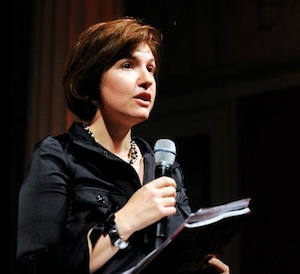 Susan Glasser always welcomes a new challenge. As editor-in-chief of
| You are subscribed to email updates from Nieman Journalism Lab To stop receiving these emails, you may unsubscribe now. | Email delivery powered by Google |
| Google Inc., 20 West Kinzie, Chicago IL USA 60610 | |