Selasa, 15 April 2014

Nieman Journalism Lab

Nieman Journalism Lab


INNovation fund backs eight projects from news nonprofits with an eye towards sustainability

Posted: 14 Apr 2014 09:01 PM PDT

INNlogo_blueA public radio app that aggregates user-generated content, a food education night with a tasting menu, and a WordPress tool that helps track the influence of stories. Those are just a few of the projects receiving funding from the INNovation Fund, a collaboration between Knight Foundation and the Investigative News Network to support make nonprofit and public media more sustainable.

Eight projects will receive a total of $236,280 in funding for ideas designed to improve technology, diversify revenue streams, or develop new audiences. Most of the projects received $35,000 or less.

The winners include Chalkbeat, InvestigateWest, the Food & Environment Reporting Network, the Iowa Center for Public Interest Journalism, Public Herald, San Francisco Public Press, WXXI Public Radio, and Southern California Public Radio. (The full list of winners is below.)

According to Kevin Davis, CEO and executive director of INN, the fund received 118 applications. Knight launched the fund with $1 million to support projects over a two year period, with three more rounds of funding. As is the case with most Knight projects, the winners will have to share their work and any code with the public. (This is a good place to note that Knight is also a funder of Nieman Lab.)

Davis said the purpose of the fund is to give smaller outlets the ability to experiment with ideas they would not otherwise have the time or resources to pursue. “One of the underlying assumptions here is, no matter how small or large your nonprofit, there isn’t $25,000 or $35,000 lying around for an experiment,” Davis said. Because the funding amounts are relatively modest, the judges were looking for projects that expand on existing work rather than building from scratch.

“The organizations we ended up funding clearly have been working on some of these concepts for a while and were looking for an opportunity to experiment and ways to invest,” Davis said.

That includes MORI, a tool developed by Chalkbeat to measure the influence and reach of their stories. The $28,280 in funding they’ll receive will go towards building a new feature that will help Chalkbeat target specific audiences for their work.

The Iowa Center for Public Affairs Journalism will use its $25,000 in funding to launch a weekly radio program and a series of public forums based around the center’s reporting. Covering topics like farm safety, migrant labor, and meth addiction, the Center will create 13 23-minute shows that will air on commercial radio stations.

Overall the projects echo some of the ideas and experiments seen elsewhere in the journalism world, like event programming, native advertising, and cross-media collaboration.

Seattle-based InvestigateWest plans to use its $15,000 in funding to partner with public radio station KUOW on radio series grounded in the site’s investigative reporting. Jason Alcorn, associate director of InvestigateWest, said the site regularly collaborates with other local news outlets like King 5, The News Tribune, and KUOW.

Alcorn said the funding will be used to figure out the right format for the program and to perform some market research. Ideally, the program would combine the investigative work and data-backed analysis of InvestigateWest with the audio-friendly narrative storytelling of KUOW, Alcorn said.

The plan is to find underwriting specific to the program, along with individual support from KUOW members and revenue from events tied to the show. “The idea is its revenue positive and self-sustaining going forward, Alcorn said.

The Food & Environment Reporting Network will use its $35,000 in funding to launch an series of events called FERN Talks & Eats, that combines live stories about food with dishes prepared by a chef. Tom Laskawy, cofounder and executive director of FERN, said over email: “Our primary hope is that the event is an entertaining and delicious experience attractive to a paying audience as well as to corporate sponsors. The ultimate goal is to repeat and replicate our initial event in different cities and generate an on-going revenue stream.”

Southern California Public Radio, which is receiving $35,000 in funding, is developing a native advertising program for its desktop and mobile products. According to their application, they plan to run a pilot program for “native underwriting” over the course of six months. “Usually the focus is on innovation in the newsroom and around the editorial product,” said Alex Schaffert-Callaghan, digital media director for SCPR. “But now the time has come and we have to stop complaining about the lack of new revenue and innovate.”

Schaffert-Callaghan said their goal is to create native underwriting that is on par with commercial media companies, but meets the ethical and journalistic standards of public radio. That means crafting a design and messaging that draws clear lines between sponsored underwriting and editorial content.

For a project to be successful, it’ll need to have a system in place that makes creating native underwriting an easy process but also has support from the sales team and the newsroom. “We have every incentive to do this well, because anything less would hurt our brand. And frankly, we can’t afford that,” she said.

One thing all of the projects share is a focus on growing audience, either for the purpose of raising revenue or simply to attract a larger readership. Davis said the idea of user acquisition, and devising strategies for growing an audience, is a relatively new concept for parts of the news business, and one that’s especially important for nonprofits, many of which have small audiences. “If your mission is to inform the public, you have to experiment with different media and partners to reach those folks,” Davis said. “It’s about informing them where they are, not bringing them to where you are.”

Knight Foundation has long been in the business of supporting media, especially the growing sector of nonprofit online news, and its efforts of late in the local space have focused on helping media organizations reach a level of financial stability outside of foundation support.

Davis said the winning projects, and those to come in subsequent rounds, need to be able to show they can live on without continued support of grant funding. The point of the the INNovation fund is to move organizations along the chain towards sustainability, not to experiment just for the sake of experimenting.

“If the projects themselves don’t have an expectation of breaking even then we have a hard time looking at them as helping sustainability,” Davis said.

Chalkbeat

Award: $28,280
Twitter: @chalkbeat

Description: Chalkbeat has developed a tool called MORI (Measures of Our Reporting's Influence), a WordPress plug-in developed last year and launched this past February. This project will add a new feature to MORI to help Chalkbeat plan their stories for maximum impact, and then track the influence they have in the real world. It is a CRM (constituent relationship management) tool linking MORI's database of metadata on individual stories' target audiences, types and topics to Chalkbeat's efforts to distribute stories to readers or groups of readers directly and through the network of distribution partners in each bureau. It will streamline their systems for getting stories directly into the hands of people most likely to be interested in them. The goals of this project are to boost the ability to attract paid sponsorships, increasing their appeal to national/local sponsors, and helping to retain and grow philanthropic revenue.

Food & Environment Reporting Network

Award: $35,000
Twitter: @fernnews

Description: FERN project is an event called "FERN Talks & Eats." It will feature up to three FERN reporters live on stage, sharing and presenting dramatic episodes about food and food issues, working with a stage director to craft a dynamic, engaging and entertaining experience that draws a wide audience. This will be paired with a high profile chef who will interpret the foods at the center of each story, producing various dishes for participants to eat. The kind of stories they will feature will focus on current issues on topics such as how food is grown and processed, food smuggling, factory farm pollution, gluten-free products giving rise to infant celiac disease, and many more. FERN plans to present the first event in New York in late 2014. They will charge a minimum of $60 per person and accommodate up to 250 guests, with additional revenue from corporate sponsors. This will lay the groundwork for future similar events in NY and other communities. FERN has done this once before on a smaller scale. Its success is why they feel they can produce a larger prototype event to eventually become a series of events in other communities, and which will increase audience and revenue.

InvestigateWest

Award: $15,000
Twitter: @invw

Description: This grant will support a collaborative project with Seattle NPR affiliate KUOW to launch a new branded radio series, coupling IW's investigative know-how with KUOW's audience reach. This series will allow listeners to look forward to broadcasts, find related material online, and support the series financially. Investigate West will provide the foundation of a story through data analysis, public records and traditional reporting, and KUOW will add the narrative storytelling to make for must-listen radio. The unbundled pieces will air during drive time. Both organizations will benefit from opportunities to increase audience engagement generated: in-studio interviews, public conversations with sources and experts, a podcast, and documentary photography exhibitions. While an ambitious project, both organizations expect to create several paths to sustainability and ultimately cover 100% of total operating costs going forward.

Iowa Center for Public Affairs Journalism

Award: $25,000
Twitter: @iowawatch

Description: The Iowa Center will develop a statewide audience engagement program that takes its reporting to new audiences via two methods: a weekly statewide radio program, and IowaWatch-based public forums in cities where the program is aired. The goal is to expand audience and reach more potential personal and corporate funders through donations, underwriting and advertising than is now done through heavy reliance on newspapers. IowaWatch will hire a consultant who is an experienced broadcaster with a deep background in, and connections to, Iowa media. He will also act as producer and host of the radio programs. Commercial radio stations will be selected based on their location, signal strength, and commitment to community-based programming and service. Ten stations are targeted for placement of a 23-minute program, with plans for 13 shows in the first and second phases of the project. These airings will be followed up with community forums in those areas where the issue is resonating. Video will also be created. Topics to be covered will include farm safety, working conditions for seasonal migrant farm workers, meth addiction among mothers, and narrowing the opportunity gaps that exist among white, black and Latino residents. Many of these topics are critical during upcoming political campaigns. Staffing for the project will include student journalists.

Public Herald

Award: $35,000
Twitter: @publicherald

Description: Public Herald will undertake a screening and discussion tour of its investigative documentary 'Triple Divide' through several key areas where hydrofracking is proposed across the US – Virginia, North Carolina, Florida, New Mexico, California, Michigan and key areas in between where onshore unconventional oil and gas development via fracking is being planned or is in initial stages. Triple Divide, narrated by actor Mark Ruffalo, is the result of an 18-month investigation into negative impacts from fracking in Pennsylvania since 2008 and how those impacts are handled by regulators and industry. These tours have increased Public Herald's member base by over 220% in just 11 months. Each event will consist of a screening of the film and discussion with local groups, elected officials, media and the public. Also, each community will be introduced to Public Herald's new open source #Fileroom project, making otherwise invisible data about citizen reports of fracking impacts available to the public as digital files organized by state, country and township. They also plan to cross the nation in a zero emissions vehicle and share the experience as a test drive and rolling review on their website. Each forum will also provide information on Public Herald membership to attendees. It includes monthly updates and exclusive benefits.

San Francisco Public Press

Award: $35,000
Twitter: @sfpublicpress

Description: SF Public Press plans to launch a street mobilization program to increase visibility of the organization, expand audience and grow readers who are most likely to become paid member-subscribers. They will deploy a crew of 4 street hawker-canvassers to participate in and track public-facing activities, including: selling the quarterly ad-free paper for $1/copy; offering free papers in exchange for signing up for the weekly email newsletter; surveying people about their interest in supporting public media; and soliciting donations. Hawkers will be equipped with I-pad Minis to demonstrate the news site and to gather email addresses, collect responses and process donations. This program will enhance their upcoming Pedal-Powered News initiative, an effort to expand distribution and increase engagement using bicycles to deliver the newspaper to nearly 100 retail locations and community centers and to members' homes across San Francisco. This is hopefully to be funded by a Kickstarter campaign being launched this month, with matching funds from the Knight Foundation. Ultimate goals of the street hawker program are projected to be an increase in the newsletter mailing list to 4,000 (currently 1,400); income from newspaper sales to double the current six-month sales income; and growing six-month paid revenue from memberships by 75%. Very ambitious, but because of the density in San Francisco which is conducive to grassroots marketing and numerous community events and seasonal public gatherings, SF Public Press is in a good position to succeed.

Southern California Public Radio

Award: $35,000
Twitter: @KPCC

Description: SCPR hopes to solve the riddle of native advertising for nonprofit news organizations. They will create, within the legal limitations placed on public media, a scalable native underwriting convention that delivers value to both audience and the underwriter. The end framework would preserve public media's common mission and values, while driving digital revenue growth. The grant will enable SCPR to contract with a strategist for six months to design and implement a pilot native underwriting campaign. Sponsored content will appear in contextually relevant placements across SCPR's digital products for both listeners and readers on mobile/desktop platforms. They will commit to beginning one sold campaign before the conclusion of the pilot program, although it may last longer. SCPR feels that offering sponsored content packages to SCPR's funders is the logical next step for monetizing its digital products, while keeping pace with private-market competitors. An outside digital marketing firm will work with SCPR staff and also a native sales consultant to develop the campaign, which will be with one sponsor. Key concepts will include taking care that sponsor content is distinctly different visually from editorial content and that it is clearly identified as sponsor messaging. In details of design and execution, SCPR intends to follow the most explicit precedents set by other news organizations, including clear sponsorship marks in the URL, header and footer, overall design aesthetic, and body copy.

WXXI

Award: $28,000
Twitter: @WXXIrochester

Description: This grant will help develop and roll out a mobile app to encourage and streamline aggregation of user-generated content. The goal is to broaden audience engagement, primarily with younger, mobile and under-represented community members. The initial phase will focus on adolescents. The app will be available in English and Spanish, and its design will emphasize visual and intuitive prompts, accessibility and whole platform will bridge smartphone, SMS and web platforms. A consortium of community media and educational partners will collaborate to promote the technology, encourage participation and exchange and collaborate on the resulting content. These partners include the legacy African-American community station in Rochester, Hacks and Hackers, a local college's department of adolescent education, and the journalism school at Rochester Institute of Technology. A pool of shared content would be available to support broadcast content including news coverage, informing community discussions within under-represented audiences, and in existing WXXI outreach programming, including a voter empowerment and information initiative, a media literacy program for ages 12-24, and a community engagement project around accessibility issues. A media campaign to build awareness will be rolled out online and via broadcast and social media around a working theme of "Share Your Story." Working with Action for a Better Community, a local Rochester nonprofit assisting low-income families, the project will help partners provide informational events to: neighborhood meetings in low-income areas; inner city neighborhood centers and YMCAs; refugee community groups and support agencies; agencies that comprise the Center for Community Health; and the Al Sigl Community of Agencies which promotes inclusion for the disabled. There will also be a mobile kiosk presence in public markets and the new bus interchange. RIT students will build their own content using the app to share and also engage in hands-on demonstrations to support capacity among the focus demographic.

“Not white. Not male. Fast”: John Cook addresses what’s happening and who they’re looking for at The Intercept

Posted: 14 Apr 2014 02:13 PM PDT

John Cook, editor in chief of The Intercept, responded to a Pando Daily piece that posited the site had suddenly gone silent after its launch in February.

Cook writes that the magazine will continue to publish NSA stories, but will otherwise hold back on publishing until they resolve “questions about the site's broader focus, operational strategy, structure, and design.”

In a very Denton-esque maneuver, Cook then opened the comments to readers, saying he’d be available all afternoon to answer questions about plans for the digital magazine.

Regarding their publishing schedule and content formats, he writes:

We will be publishing a wide variety of stories — short, fast posts to keep the site alive to the news and lengthy reported narratives to devote attention to stories that need to be told, and all manner of story in between. And we will definitely be working with filmmakers — already are, in fact — to find ways to tell these stories beyond just blocks of text.

On who he’s looking to hire:

Not white. Not male. Fast. Interested in reporting as a live, iterative process that plays out on the internet as well as one where you go away for six weeks and come back with 4,000 words. Eager to make a name for themselves. Beat-wise, intelligence and national security are obviously important to us at the initial stages, but I'm more interested in good capable people who can apply their skills to all manner of stories than subject-area experts.

On tone:

Long term, I want the site to be identified more by the posture that Glenn, Laura, and Jeremy exemplify — aggressive, honest, impolite when necessary, and unburdened by the institutional norms that govern the behavior of so many reporters at major establishment news organizations — than any menu of beats or subject areas.

On coverage:

We will definitely have international coverage. Not so sure about bureaus in the short term.

On user experience and commenting:

It's a high priority, but it's not likely to be the first thing to get changed. We really want a good commenting system and we're working on it. But the first-order priority is getting the site design where it needs to be and getting the editorial structure in place to be a rolling, live operation. But yes, comments are desperately in need of improvement.

On matters of church and state:

My position is that we have publicly been guaranteed complete editorial independence (https://firstlook.org/about/). Any interference in our editorial work would be an abrogation of that agreement. I have every expectation that it will be honored. Our credibility comes from the work we have done and will do, not from our financial backer.

What’s the return on investment for news video? Tow looks at strategies in 125 newsrooms across the country

Posted: 14 Apr 2014 11:08 AM PDT

Columbia’s Tow Center has a new report out today on how publishers are actually dealing with video. Many newsrooms have made video a major focus and are pinning their hopes for revenue on the medium.

Columbia assistant professor Duy Linh Tu led a cross-country investigation into how newsrooms, broken down into categories of newspapers, digital-native properties, and longform filmmakers, are actually dealing with video content. His team compiled the results into Video Now, a structured interactive website with lots of video features. Here’s a sample of testimony from journalists at The Seattle Times:

Eric Ulken: We haven’t figure out the business model, so it's sort of a chicken or egg problem. On the one hand, advertising will tell us, "Well, we need more volume in order to make this an effective advertising product.” And on the news gathering side, it's “Well, if you could show us that this is actually producing some revenue, we would assign it some more manpower to it.”

Danny Gawlowski: For news situations, if it’s something that’s important today, we try to use mobile as much as we can, and shoot it on mobile, upload it directly from your mobile device, publish it immediately. It gives us the advantage of speed. We put the ability to publish breaking news right at the reporter level, right at the photographer level, and so that we can concentrate our editing resources on longer-term, more thoughtful packages.

The digital investigation focuses on Mashable, NPR, and NowThis News. Here’s Mashable’s Bianca Consunji on metrics for video:

We're trying to work on videos that will give us at least 20,000 views. Anything less than that, with our limited resources, just isn’t worth it anymore. If, let’s say, 100,000 people will watch a cute viral video featuring a Muppet and a cat, maybe 20,000 will watch the video that we did on 3D gun printing.

The report wraps with a good set of recommendations. Sports videos and explainers did well across newsrooms, they found, and evergreen video content with a long tail is always helpful. Social video should be about audience not gimmicks, and short videos tend to get the most viewers. Video ads should be better, and newsrooms can’t expect to depend on preroll CPMs entirely. Finally, the report advises that breaking news reporters doing short, mobile clips should be separate from those producing elegant, sophisticated, in-depth video content.

What are the kinds of legal problems online publishers run into today? Here’s an analysis

Posted: 14 Apr 2014 08:42 AM PDT

digital-media-law-project-dmlp-cmlpWhat are the biggest legal issues affecting online news organizations, large and small? One group that has a unique perspective on that question is Harvard’s Digital Media Law Project, which for more than four years has run the Online Media Legal Network, which provides pro bono or low-cost legal services to digital publishers.

In a new report out today, DMLP’s Jeff Hermes and Andy Sellars look at the 500-plus cases they’ve handled and try to determine some trends in the legal questions they’re being asked — around issues like contract negotiations, corporate law issues, intellectual property, other types of litigation, risk management, and news gathering. Here’s a summary of some of their main findings:

Those who have sought help from the OMLN overwhelmingly create their own original content, rather than aggregate the content of others. Many also provide support services to other journalists, platforms for users to talk to one another, or tools to access primary source information.

While some clients report on niche issues, many more are focused on reporting news of general interest, either to the public at large or local audiences. Non-profit clients show a greater focus on reporting on social issues such as health and education than for-profit or individual clients.

OMLN clients show significant evidence of forward planning. They are more often proactive than reactive to legal issues, frequently seeking assistance with intellectual property, content liability, and corporate questions before crises occur.

Individual clients not employed by an organization, and those clients who reported on businesses or to consumer audiences, sought help defending against legal threats more often than other clients. This indicates a particular need for greater litigation assistance among these categories.

The advice sought by OMLN clients with regard to intellectual property matters shows a near-perfect balance between protecting their own content and using the content of others

Religious but not Mormon? The church-owned Deseret News considers you a growth market

Posted: 14 Apr 2014 07:45 AM PDT

The Deseret News is owned by the Church of Jesus Christ of Latter-day Saints, but you might not detect its Mormon roots from looking at the outlet’s national site — officially came out of beta yesterday — which focuses on the self-proclaimed values of family and faith. Even in its faith section, which includes stories as wide ranging as a preview of a new PBS documentary on the history of the Jews and a piece on the Hindu holiday of Holi, there’s very little explicit coverage of Mormonism.

And that’s on purpose, says Deseret News and Deseret Digital Media CEO Clark Gilbert. “The national edition is deliberately targeting values across all faith practices in the country,” he told me.

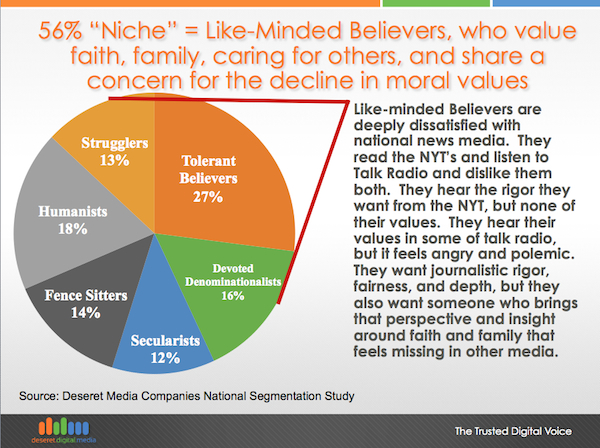
Fifty-six percent of Americans are “Like-Minded Believers, who value faith, family, caring for others, and share a concern for the decline in moral values,” according to an internal Deseret Media Companies study. That’s the audience Deseret News is aiming to capitalize on with its expansion of coverage. Gilbert said Deseret’s coverage, both local and national, is built on six tenets that it says matter to that readership — family, faith, education, care for the poor, values in media, and financial responsibility.

DeseretStudy

“We heard a lot of people saying, ‘We read The New York Times and we watch Sean Hannity, and we hate them both,’” Gilbert said of how Deseret News approached the development of its national content.

“They said, ‘We admire the rigor of The New York Times, but we don’t hear any of our values reflected there. Somehow we hear some of our values in Sean Hannity, but it feels angry and polemic. They were mashing together what the market wasn't providing, which was a thoughtful news source that was journalistic and rigorous and accurate but was asking questions that really resonated to things that mattered to their family.”

By staying away from an explicit focus on its own religion, Gilbert said Deseret News hopes to create a broad dedicated readership. “This is a huge audience, but the second you go denominational, they fragment,” he said. “Mormons read Mormon content, Catholics read Catholic content, Baptists read Baptist content.”

With all the challenges facing locally based news organizations, it’s a natural move to try to find a local beat that can attract national interest. The Boston Globe, for example, plans to launch a site focused on Catholic coverage. And, as Gilbert mentioned to me several times, The Washington Post and The Wall Street Journal have long been read outside of Washington and New York because of their coverage of politics and finance.

Gilbert, a former Harvard Business School professor, is known for his work around Christensenian disruption theory; you can see him talking about his work at an event here at the Nieman Foundation last year:

In this case, Deseret News is building on an existing print product. In 2011, it launched a weekly national print edition, and its success — with subscribers in all 50 states — hastened the launch of the standalone national website. Deseret News’ national print edition has about 75,000 print subscribers, with 15,000 of those added in the past year, according to Gilbert. It also syndicates its content to more than 400 different publications around the United States, Gilbert said. The growth has been received well by advertisers, and Deseret has been able to staff up to launch the nationally focused site.

Founded in 1850, the Deseret News — Deseret was the original proposed name for an outsized version of what eventually became the state of Utah — still publishes daily in Salt Lake City. Mirroring industrywide trends, Deseret’s print display ad revenue fell 30 percent between 2008 and 2010. Print classified revenue plummeted 70 percent. Deseret News slashed costs by 42 percent, and in August 2010, it laid off 85 staffers. It also launched a new organization, Deseret Digital Media to grow the company’s websites. Deseret’s network includes a number of local Salt Lake City radio and TV outlets — including long-time digital classifieds superstar KSL.com — as well as Mormon-focused sites, including the independent Mormon Times, the LDS Church’s official news site and an online Mormon book store. Gilbert wrote about the evolution of Deseret Digital Media in an article in Harvard Business Review. Here at the Lab, Jonathan Stray got into elements of the national strategy — including the launch of a family-friendly movie guide — back in 2012.

The standalone national site, with its trendy rectangle-heavy design, launched in beta in February and was formally launched Sunday with a ten-part series on the role of the Ten Commandments in modern life. The rollout of the site and the feature was timed for Passover, which starts Monday at sundown, and Holy Week, which culminates with Easter on April 20.

The site will feature original content, cross-posted on the Deseret News local site, but it will also feature plenty of aggregated content as well. “It’s almost like The Atlantic Wire or RealClearReligion, but with our brand voice,” Gilbert said.

Despite the conservative editorial leanings of the main newspaper, Gilbert said the national site would not take political stances. For instance, Last month, the site published a story on a Pew Research Center study that showed an increase in acceptance of same-sex marriage by black Protestants. Compare that with the front-page editorial the Deseret News ran with the headline “Judicial tyranny” after a federal judge struck down Utah’s ban on same-sex marriage last year.

Part of that national move is partnerships. In February, Deseret News partnered with The Atlantic to produce a series, published on both publication’s websites, about the role of fathers in American society. The seemingly unlikely partnership between Deseret News and the Washington-based monthly received a fair amount of press coverage when it was announced, and Gilbert said it was “absolutely the case” that Deseret News will continue to partner with other outlets. He said he was in discussions with two organizations about partnerships, but said nothing was finalized.

“We’re a serious news organization and we want to partner with people who want to do great work,” Gilbert said.

Photo of an old-fashioned Deseret News delivery cart by Edgar Zuniga Jr. used under a Creative Commons license.

Sabtu, 12 April 2014

Nieman Journalism Lab

Nieman Journalism Lab


Connecting place to product: Nikki Usher’s new report on the physical shifts of digital newsrooms

Posted: 11 Apr 2014 07:59 AM PDT

Our friend Nikki Usher is out with a new report today at the Tow Center (pdf here) on the role of physical space in newspapers making the transition from print to digital. With shrinking staffs, a desire for cultural change, and a reduced role for printing plants, lots of newsrooms have moved in recent years. What difference can a change of scenery make?

As newsrooms shed their old, industrial pasts through optioning real estate, then perhaps the future for post-industrial journalism is quite bright. But if these moves are about nothing more than downsizing and loss, then we ought to be deeply concerned about the viability for quality news in the digital age, particularly from metropolitan newsrooms.

The task of this paper is to explore how physical change might make a difference to the future of journalism. The goal here is to help those inside and close to the industry understand the transition newspapers are making away from their manufacturing roots and into their post-industrial present. The relationship between physical and digital space, and what it means to journalists and their work, should help us learn more about what is happening inside journalism — and hopefully offer some insights into opportunities and blind spots.

nikki-usherNikki’s paper builds on a number of pieces about newsroom space that have run here at Nieman Lab (one, two, three). Among the questions she addresses in the paper:

— Can a move to a new physical space help to update newsroom culture? Can it serve as a digital do-over?

— Does moving to a post-industrial space — abandoning the presses out in the suburbs, say — communicate something about the nature of the newspaper to readers, advertisers, and citizens?

— How can the physical organization of newsroom space be optimized for breaking news online?

— How important is physical space when everyone has a laptop and a smartphone, anyway?

From Nikki’s conclusion:

Newsroom moves matter. Journalists are storytellers and they have always crafted their own myths about the profession. If the message now for metropolitan newsrooms is digital innovation, then it may be necessary to create a very explicit break with the past. New stories need to be created to establish a new narrative about the purpose and mission of journalism. One facet of cultural change began when online journalists were integrated into the main newsroom as equal partners. This was a story of physical space just as it was one of cultural change.

[...]

It’s easy to get wistful about the decline of newspapers. And indeed, the loss of large newspaper buildings and their imprint on their respective cities is sad to those who have sentimental attachments to old journalism. The symbolism of these moves is incredibly meaningful to both reporters and the public. For this reason, newspapers need to tell their own stories of change. They must be able to create a tale that downsizing space is not downsizing the news.

This Week in Review: Vox and the wonk boom, and Comcast defends its TWC merger plans

Posted: 11 Apr 2014 06:55 AM PDT

This week’s essential reads: If you’ve only got a minute or two, this week’s essential reads are Felix Salmon on the boom in wonk journalism, David Carr with big questions for Comcast and Time Warner Cable about their merger, and Washington Post editor Marty Baron’s reasons for optimism about the future of journalism.

Vox, tech, and wonk journalism: Former Washington Post blogger Ezra Klein launched his explanatory journalism site, Vox, this week, cautioning in an introductory note with co-editors Melissa Bell and Matt Yglesias that it’s still quite unfinished. The Washington Post profiled Klein’s new boss, Vox Media CEO Jim Bankoff, but most of the focus was on Vox’s distinctive tech.

vox-logoThe New York Times centered on Vox Media’s internally built content management system, Chorus, which was a key tool in recruiting Klein. Ad Age looked at Vox’s “card stacks,” the system the site is using to break their explainers into digestible chunks for readers. That includes cards to note how card stacks have been altered for corrections or changing events, as Poynter reported.

Initial reviews were curious but critical. The Columbia Journalism Review’s Greg Marx saw Vox as a welcome test of Klein’s argument that what news needs are more clear and helpful entry points for complex, ongoing stories. Mathew Ingram of Gigaom liked Vox’s clear purpose and “cards” organization format, but expressed concern that it’s going to have to compete with Wikipedia and lacks a personal orientation. The Wire’s Allie Jones said many of the initial cards “don’t seem to provide any information that you can’t get on Wikipedia or About.com.” PandoDaily’s Nathaniel Mott was also skeptical, referring to the cards as “glorified slideshows” and describing the style as “BuzzFeed written by a college professor.”

Vox’s launch also reignited the discussion about Klein’s departure from the Post after his proposal for an explanatory journalism site there was turned down. The Times article on Vox quoted Klein as saying he was “badly held back” by the technology and the culture at the Post, though it later edited it to refer to newspapers in general, not just the Post. At a conference last weekend, Post editor Marty Baron said Klein had proposed an entirely new news organization separate from the Post, rather than an expansion of his Wonkblog.

Mathew Ingram said Baron’s justification makes decent financial sense, but starting sites like Vox are precisely the bets the Post should be taking in an attempt to survive the disruption of news. Similarly, Reuters’ Felix Salmon said Klein made the right decision by going with a nimbler company and voiced his doubt that the Post is the best place to develop the wonky journalism that’s so popular right now. “In general, the bigger and more entrenched the media company you're part of, the harder it is to get stuff done,” he wrote.

In another piece for Politico, Salmon explained why analytical journalism like Klein’s and Nate Silver’s is experiencing a boom, and Laurie Penny of the New Statesman questioned why white men like Klein and Silver are being feted as the future of journalism: “These, it turns out, are the kind of ‘outsiders’ the old guard can cope with: outsiders who look almost exactly like them, except younger and cooler.”

comcast-cc

Comcast and the competition: Comcast and Time Warner Cable started down the regulatory road toward their proposed merger this week, appearing before a U.S. Senate Judiciary Committee that was mostly skeptical about the value for consumers of a merger of the nation’s two largest cable TV and broadband providers. The New York Times’ David Carr asked several critical questions about the merger heading into the committee hearing, noting at one point that because of its size in the broadband market, a combined Comcast/Time Warner “may have an effective veto over the programming and technological innovations of others.”

The two companies also made the case for their merger this week in a filing with the Federal Communications Commission, arguing that they’ve been diligent about trying to improve their service and that they’re trying to defend themselves against the competition of streaming video services like Netflix, Roku, and Apple TV. Variety and Ars Technica gave closer looks at their arguments.

Several other writers picked those arguments apart, particularly Comcast’s claim to be one of many little guys in a giant pool of competitors. The Verge’s Adi Robertson, Recode’s Amy Schatz, and Techdirt’s Mike Masnick all dissected Comcast’s list of competitors, noting that many of those competitors rely on Comcast and Time Warner for distribution of their online streaming services, and that cable providers rarely compete directly with each other because they’ve largely divvied up various geographical areas among themselves. Gigaom’s Stacey Higginbotham also had some critical questions for regulators to ask, and the Daily Dot’s Andrew Couts poked holes in Comcast’s avowed embrace of net neutrality.

More than 50 groups sent a letter to the FCC objecting to the merger, and some conservative groups have joined the fight against it as well, though as BuzzFeed’s Peter Lauria explained, no major TV content providers have opposed the deal. As the Sunlight Foundation’s Palmer Gibbs noted, however, Comcast and Time Warner have been very politically active, with their employees giving millions of dollars to many of the key political figures in the upcoming regulation decisions.

heartbleedHeartbleed’s quiet leak: Experts discovered a security bug this week, called Heartbleed, which has quietly left a great deal of the web’s encrypted information open to hackers for two years. The best explainers on Heartbleed are by Vox’s Timothy B. Lee, Gigaom’s Mathew Ingram, and NPR’s Jeremy Bowers, but here’s the very quick summary: Heartbleed is an opening in the popular OpenSSL encryption software that could let hackers into information on servers that isn’t even part of the server’s initially encrypted information. Other than changing passwords once a site has patched the leak, there’s not much users can do to protect themselves at this point — most of the work is on web companies’ ends. At Source, Mike Tigas gave some valuable tips to newsrooms on dealing with the bug on their sites.

We don’t know who, if anyone, has taken advantage of Heartbleed — as Charlie Warzel of BuzzFeed noted, the most likely culprit may be the U.S. National Security Agency. The New Yorker’s Rusty Foster went deeper into the roots of the bug, noting that it’s partly a function of an OpenSSL that’s run by a small group of volunteers and relies on an old and more vulnerable programming language (C). “If open-source software is at the heart of the Internet, then we might need to examine it from time to time to make sure it's not bleeding,” he wrote. Farhad Manjoo of The New York Times also addressed the difficulty of keeping the web’s security up to speed with its growth.

Reading roundup: Several interesting conversations popped up around journalism and tech this week. Here are a few worth following:

— Tech entrepreneur Chris Dixon lamented the dominance of apps over the mobile web, arguing that apps are governed by a rich-get-richer dynamic and subject to the whims of the keepers of the app stores. Tech blogger John Gruber disagreed, saying that whether we’re talking about apps or the mobile web, it’s all the web. Venture capitalist Fred Wilson said the shift to apps has led to less risk-taking in tech entrepreneurship, and blogger Ben Thompson argued that the web still matters for writing. Gigaom’s Mathew Ingram summed up the discussion and emphasized the importance of links.

— Poynter’s Howard Finberg and Lauren Klinger released a report comparing the views of journalists, journalism educators, and students about which skills are important in journalism, finding that educators view technical skills — especially multimedia — as much more important than professionals do. Meanwhile, journalism professor Mindy McAdams took a couple of looks at what multimedia journalism skills mean today and what skills are necessary for journalism students to learn.

— Twitter introduced new profiles this week that emphasize photos and look a lot like Facebook’s. PandoDaily’s Nathaniel Mott said the changes are a good thing, as they “showcase a Twitter willing to move beyond its simple, what-you-see-is-what-you-get roots in order to create a more approachable service.”

— Finally, several great reads to look at this weekend: Poynter’s Roy Peter Clark on what it takes to create a new mode of journalism and whether data journalism qualifies, Adrienne LaFrance on rethinking online news archives, News Corp.’s Raju Narisetti with 26 key questions to ask about news organizations’ move to digital, and Washington Post executive editor Marty Baron on reasons to be optimistic about the future of journalism.

Photos of “Wonky” sign in Los Angeles by Payton Chung and Comcast remote by MoneyBlogNewz used under a Creative Commons license.

Jumat, 11 April 2014

Nieman Journalism Lab

Nieman Journalism Lab


What does Heartbleed mean for journalists?

Posted: 10 Apr 2014 08:19 AM PDT

Yes, you need to reset all your passwords. But what are the specific impacts for journalists regarding the Heartbleed security breach announced yesterday? For Source (and also the ProPublica Nerd Blog), Mike Tigas has a breakdown.

If your websites have SSL enabled (when users log in, for example), or if you use VPN software to secure your network, or if you run your own mail servers, your newsroom might be affected by Heartbleed.

Heartbleed can affect anything that uses OpenSSL version 1.0.1 or greater. This includes most open-source webservers (Apache, nginx, lighttpd), and can include email servers, instant message services (ejabberd, etc), and VPN servers (openvpn). Privacy software like Tor and SecureDrop are also vulnerable and have since released updates. Many popular server operating systems are affected and have released patches that fix the bug, including Linux distributions like Ubuntu, Debian, Fedora, Red Hat Enterprise and Arch Linux. [...]

If you get a version between 1.0.1 and 1.0.1f, you may be vulnerable. Some Linux distributions include a hotfix for this bug while keeping the same version number, so you should double-check the operating system's website for more information.

Tigas’ post has specific next-steps for those who may be vulnerable. In addition, ONA’s Jen Mizgata suggests journalists whose hackles are raised by the bug consider attending their security summit this month in Indianapolis.

The newsonomics of 50/50 and the unchaining of the U.S. press

Posted: 10 Apr 2014 08:16 AM PDT

Asked last week whether he was buying the Star Tribune for business or altruistic reasons, Glen Taylor said a lot in a two-word answer: “50/50.”

News observers have parsed and poked at every recent big buy over the last year. Is this the turnaround? Why are these billionaires buying? What do they see? What’s the reason?

Life — even business — is sometimes a little more nuanced. We race to make money, even when we seemingly have enough. We acknowledge our roles within our wider communities. 50/50 is a perfect way to capture the spirit of some of the new personalities and money entering news company ownership. Almost all of them have a sense that they are buying near a financial bottom. And of course, there’s the ego-stroking that still comes with putting your name atop a masthead. Then there’s the mix of civic and sometimes political motivations we see ushered in by these new owners. It’s never quite a perfect 50/50 split, of course, and it varies with each of the new owners.

50/50, though, is an eloquently simple way to describe this new era of Bezoses, Buffetts, Henrys, and Taylors. Warren Buffett has been the most obscure in his motivations, but that’s explained by his use of publicly traded Berkshire Hathaway as a buying vehicle. John Henry laid out civic motivations in a way we haven’t heard from incumbent publishers in a long time, in his fall piece “Why I Bought the Globe.”

Now that new class of owners has unexpected company: Alice Rogoff.

Rogoff (illuminating in-house bio here) shot to national prominence Tuesday. Her purchase of McClatchy’s Anchorage Daily News for $34 million, and its planned merger with her six-year-old digital startup the Alaska Dispatch, re-electrified the local news debate. Another billionaire buying; another chain selling. Is it a trend? Are we seeing the deconsolidation of the U.S. press?

Our new Alaska tale can be read as a David taming a Goliath. The digital-only Alaska Dispatch, with a scrappy staff of less than 20 journalists, takes over the print incumbent, with the Daily News’ publisher and editor retiring with the sale. (While the Dispatch is small, it’s not a perfect David: Rogoff is a former chief financial officer of U.S. News and World Report, and her husband David Rubenstein has an estimated net worth of $3.1 billion.)

Rogoff, 62, shares that sense of place, of legacy, and of impact with Glen Taylor. Last week, the group that bought the Star Tribune out of bankruptcy in 2009, announced it was agreeing in principle to sell to Taylor, best known for owning the Minnesota Timberwolves. Seventy-five percent of the ownership has been split among GE Capital and the local Wayzata Investment Partners, and they’ve been rewarded for their above-average stewardship of the Star Tribune (“The newsonomics of Pulitzers, paywalls and investing in the newsroom”). I estimate the sale price at about $100 million, built both on healthy profits of $20 million-plus and an ahead-of-the-curve community-reaching, ad-servicing, reader-paying strategy. We knew the current owners were involved for the short term; the news here is that ownership will stay local, have deeper pockets, and keep management in place.

Glen Taylor is a 72-year-old Minnesota-bred billionaire who earned his way to his mini-Buffett empire of 50 or so companies through Taylor Corp., along with ownership in 30 other companies. He also has served as a moderate Republican state legislator from 1981 to 1990. He grew up reading newspapers and understands the value of a strong news organization in the life of a city (or two) and a state.

“I’m interested in this one because it’s a Minnesota paper,” Taylor told the Star Tribune. “For the long run, if we can continue to have a news media that’s consistent, fair, broad-based…I think it’s in the interest of our state. I would be proud to be part of that.”

Taylor and his fellow new newspaper publishers share at least three qualities. The first is what gains the headlines: They’re billionaires. They have enough money to buy a property worth a tenth or so what it would have gone for 15 years ago. Second, they have civic impulses, understanding that the world is about more than making money. Third, they are optimists, now apparently on the loose.

RELATED ARTICLE
optimism-cc
The newsonomics of outrageous confidence
Washington Post executive editor Marty Baron outlined his nine excellent reasons (“Optimism is the Only Option”) to be optimistic about the news business, a seeming act of bravery in a trade that has long embraced cynicism is a professional religion. I’ve pointed to this emerging “outrageous optimism” as key driver of news business rebirth, and this week Capital New York’s Joe Pompeo pointed to it in the air in the NYT Now launch. Watch out: It could be contagious.

Let’s be clear about this particular rush of money. What’s most interesting about this spate of buys is that they are local.

National news media is in a new go-go mode, with diverse investment capital announced in the last year alone. Read Marc Andreesen’s well-noted manifesto and you can see the financial justification for everyone from Vox Media to ESPN and NBC Universal pouring millions in national/global news sites.

Then there’s Pierre Omidyar’s First Look Media, still in embryonic stages. Its founder and funder is a 50/50 figure: clear about his pro-democracy reasons for building First Look, but also envisioning it at better than break-even — though that may take more than five years. For all of the moneyed individuals now investing in news, it’s a melding of market discipline and civic value.

The one thing Andreesen left out, as he prophesied hockey-stick-like growth for new media — “The big opportunity for the news industry in the next five to 10 years is to increase its market size 100×” — is local. In fact, almost all the movement of high-profile free agent journalists — the Ezra Kleins, Nate Silvers, Matt Yglesiases, and Kara Swishers — has been within the national news sphere. That 5,000-person increase in journalist hiring, noted in Pew’s recent report? The great majority are national, especially in the wake of Patch’s demise.

The local digital opportunity is real, but it’s a tough, years-long slog. It can never offer the sheer multiplying scale of a global audience or that hockey-stick dream return. It demands patience. It requires at least a 50/50 approach to business and life. That’s why these billionaire bets are timely: They bring money and time to the business of reviving a local American press.

Will this go off the tracks in certain cities? Many will say we already have our proof in millionaire Papa Doug Manchester’s tenure owning U-T San Diego (née the Union-Tribune) in San Diego. But then again, we’ve always had a wide spread of viewpoint and journalistic quality among the daily newsrooms spread across America.

All else equal, though, local ownership is a good thing. That may be especially so in this age. Look at the broad history of chains sweeping up most of American’s dailies in the ’60s, ’70s and ’80s, and you can see all kinds of patterns. Great local papers were homogenized; wretched local papers were made much better, with some even made great. It depended on which chain owner you got in your city. Today, the financial pressure on the chains makes their own reinvestment in the print/digital future hard to pull off. So, local buyers, with deeper pockets and good intentions, can be a very good thing for the local news business and its readers.

The slow unchaining of U.S. daily journalism

We’re not seeing the end of newspaper chain journalism. But we clearly see a weakening of the links, especially in metro markets. (Consider this historical footnote: The Anchorage Daily News was McClatchy’s first outside-of-California paper acquisition, the beginning of its chain growth.) Make no mistake: The rationale for chain ownership — those sometimes-real, sometimes-elusive synergies of multiple properties across broad geographies — still has some purpose. The new, post-bankruptcy GateHouse/New Media Investment Group, funded by Fortress Investment Group, is currently the most aggressive in rollup. (Here’s a good explainer by the Boston Business Journal’s Jon Chesto.) Even as some of the old chains sell, new chains are replacing them.

Still, overall, we’re seeing some significant unchaining of newspapers. Alice Rogoff’s purchase in Anchorage is only the latest example. In the past year, we’ve seen the New York Times Co. complete the process of de-chaining itself, selling The Boston Globe to John Henry. A. H. Belo sold off its Riverside Press-Enterprise to Aaron Kushner’s Freedom Communications (now more a multi-title local news company than a chain, as it launches the L.A. Register next week) and has placed its Providence Journal on the market. When the ProJo is sold, A. H. Belo will be back to being a Dallas-area company. Could McClatchy ultimately peel back to its own California roots, with its three Bees and two other properties? The company will take $24 million in post-tax gains from the Alaska sale, as it tries to thread its needle, balancing debt reduction and digital investment. It may seem far fetched to think of a smaller McClatchy today, but consider the massive change among McClatchy’s newspaper brethren.

RELATED ARTICLE
project-thunderdome-cc
The newsonomics of Digital First Media’s Thunderdome implosion (and coming sale)
Knight Ridder, not long ago the No. 2 largest newspaper company in the company, sold itself to McClatchy eight years ago. Tribune, the No. 3, is about to spinoff (“The newsonomics of orphanage”) its all its newspapers, with follow-on sales of individual papers the greatest likelihood. MediaNews is no longer with us, merged along with the Journal Register chain into Digital First Media, which itself (“The newsonomics of Digital First Media’s Thunderdome implosion — and coming sale”) looks to be splitting apart. Media General is no longer a newspaper company, selling its largest paper, in Tampa, to single owners for a bargain price and the rest to the newest contrarian chain in the business, Warren Buffett’s Berkshire Hathaway Media.

The Washington Post has moved from a larger diversified company into the singularity of the Post itself. In the Twin Cities, the Cowles-owned paper Star Tribune went chain in 1996 when McClatchy bought it, and now has meandered its way back to individual ownership as Glen Taylor comes forward to buy the paper.

Wow. It’s dizzying change for what used to be a staid industry. Though it’s not clearly moving in a straight line, the unwinding of the chains is real. The post WWII logic of buying and building holds far less logic financially.

Beyond billionaire bingo

Billionaires can be good for the newspaper business. That’s the good news. The bad news: There aren’t that many to go around. We have a paltry 492 in the U.S., and they’re unevenly distributed geographically. (A few of China’s 152 have shown interest in U.S. media. And then there are the 111 in Russia, who may find America a more compelling investment environment in these post-Crimean invasion times.)

Still, the 0.000001% are having an impact. It may soon have more.

In L.A., Eli Broad is once again expressing interest in buying the L.A. Times — and returning it to local control. In San Diego, control — which has been local except for a brief Platinum Equity interim — looks like it is up for grabs again. Given the opportunity to rebut the notion of U-T San Diego is for sale, CEO John Lynch refused to do so.

Of course, for readers in southern California and around the country, it depends on which billionaires or multi-millionaires (yes, you qualify too) you get. You want the ones, whether Republican or Democrat, who believe in a fair, straight-ahead news report.

Consider last year’s allergic reaction to the Koch Brothers’ attempt to buy the Tribune newspapers. Through public protest and private pressure, the Tribune properties never made it to the offer sheet stage — but they’ll come back on the market some time after the spinoff. Given the Kochs’ great understanding of political influence, why wouldn’t they buy newspapers as another lever of political persuasion? As news of the DFM shakeup reverberated around the country last week, smart observers noted that one of the purplest of purple states — Colorado — could see one billionaire newspaper owner, Philip Anschutz, consolidate the state’s press. With its “stridently conservative” stance, those nine electoral votes in 2016 may swing in the balance. While the Roberts Supreme Court has widened the opening for wealthy campaign donations, owning a press still offers an old-fashioned means of influence.

To be sure, relying on billionaires to save the local day would be silly. We’ve seen all kinds of efforts — from tenacious, high-achieving, nonprofit startups to would-be for-profit digital chains, as well as financial strategizing around “low-profit” local news corps. All have their place in the renaissance. This year, though, it is the boys (and girls) with the big bucks who are making headlines.

Kamis, 10 April 2014

Nieman Journalism Lab

Nieman Journalism Lab


How The New York Times made sense of the Sochi Olympics one frame at a time

Posted: 09 Apr 2014 11:08 AM PDT

Big events — Super Bowls, the Oscars, the Olympics — are when media companies want to make sure their interactive features shine the brightest. The Olympics, in particular, are an interesting case because they last over the course of two weeks rather than one night, which means newsrooms need a continuous coverage plan in place for interactives.

sochi-olympics-logoAt The New York Times, the graphics team put together an entirely new system and set of workflows to create interactive features, including videos, photo composites, and more to cover the Sochi Winter Olympics.

At Knight Lab, Times graphics editors Wilson Andrews and Larry Buchanan explain how the planning paid off in covering the events live:

The group was divided into five three-person teams of visual journalists. Each team was assigned to an event to cover and began with an intense research and pre-reporting process in the weeks before the games. Andrews, whose team focused on figure skating, said that each journalist aimed to be as educated with their designated sport as possible before the event. They contacted sources (usually experts or ex-Olympians) with whom they would speak right before and immediately after the event so that each composite would be accompanied by thorough reporting and analysis right away.

During the events themselves, members of the team in Sochi would shoot the event and run the images through a Photoshop script they'd written prior to the games, said Larry Buchanan, a Times graphics editor. The script detected the differences between images and created a composite that was "80 percent" there, Buchanan said.

They also built a variety of modules beforehand to create composites, diptychs, or finisher's graphics depending on the sport. One of the reasons the team was able to get the graphics up so quickly is because their system allowed them to work as a singular unit.

Here’s an example of one of those composites — cooler, bigger version here:

nyt-shiffrin-composite-850x658

“Journalism is aggregation”

Posted: 09 Apr 2014 09:30 AM PDT

At The Washington Post, Joel Achenbach briefly realizes it’s turtles all the way down:

Interviewing is a craft. An interview is not quite the same thing as a conversation. There's an attempt in an interview to extract useful information, and this is a unilateral endeavor. I'm the one asking the questions here. If the source, for some reason, perhaps after an hour of badgering, asks me a question — for example, "When is this story going to run?" — I will answer in a barely audible whisper, "And you are who, exactly?"

But now I'm wondering if what I consider "reporting" is just a form of aggregating, of skimming, of lifting the best parts of a scientist's work and repurposing it for my own interests. These scientists have spent many, many years doing research, much of it at the very edge of the knowable, where finding a new piece of solid data is a laborious process that may require long nights at the computer or the laboratory bench, or mulling a bust of Galileo, and this work has to be slotted among other obligations, including grant applications, peer-reviewing papers, teaching, advising graduate students, holding office hours, serving on faculty committees and schmoozing at the faculty club. And here I am calling up and saying: "Give me the fruit of your mental labors." Asking for the ripest fruit, as it were. Asking not just for information but for wisdom. Give it to me! For free. And they did, because they always do, because we have a system of sorts.

You can find a younger, shaggier-haired version of me making this same argument — that gathering and reassembling the intellectual work of others is core to the journalistic program and has been forever — four years ago at Harvard Law School. (Also, see this 2009 piece and the comments.)

Unfortunately, Achenbach then backs off this revelation by arguing that (a) he knows some stuff too, damn it, which makes it different (I guess aggregators don’t know anything?) and (b) that learning things by making a digital telephone call somehow exists on a whole other plane of existence from learning things by using a digital research tool. It’s the old Puritan idea of the cleansing power of labor — that when things become easier, they lose their worth. Oh, well.